|
THE FOOTBALL ASSOCIATION LAWS FOR MINI SOCCER
FOR PLAYERS (BOTH BOYS AND GIRLS OVER THE AGE OF 6 AND UNDER 10) Please note: Where Leagues operate Under 11 Mini soccer events, they must follow these Laws Except where other provision in these Laws are made, the Laws of Association Football apply. Each Law is numbered to correspond with the appropriate Law of the Game. These Laws are mandatory unless special permission is granted by The Football Association. |
|
|
|
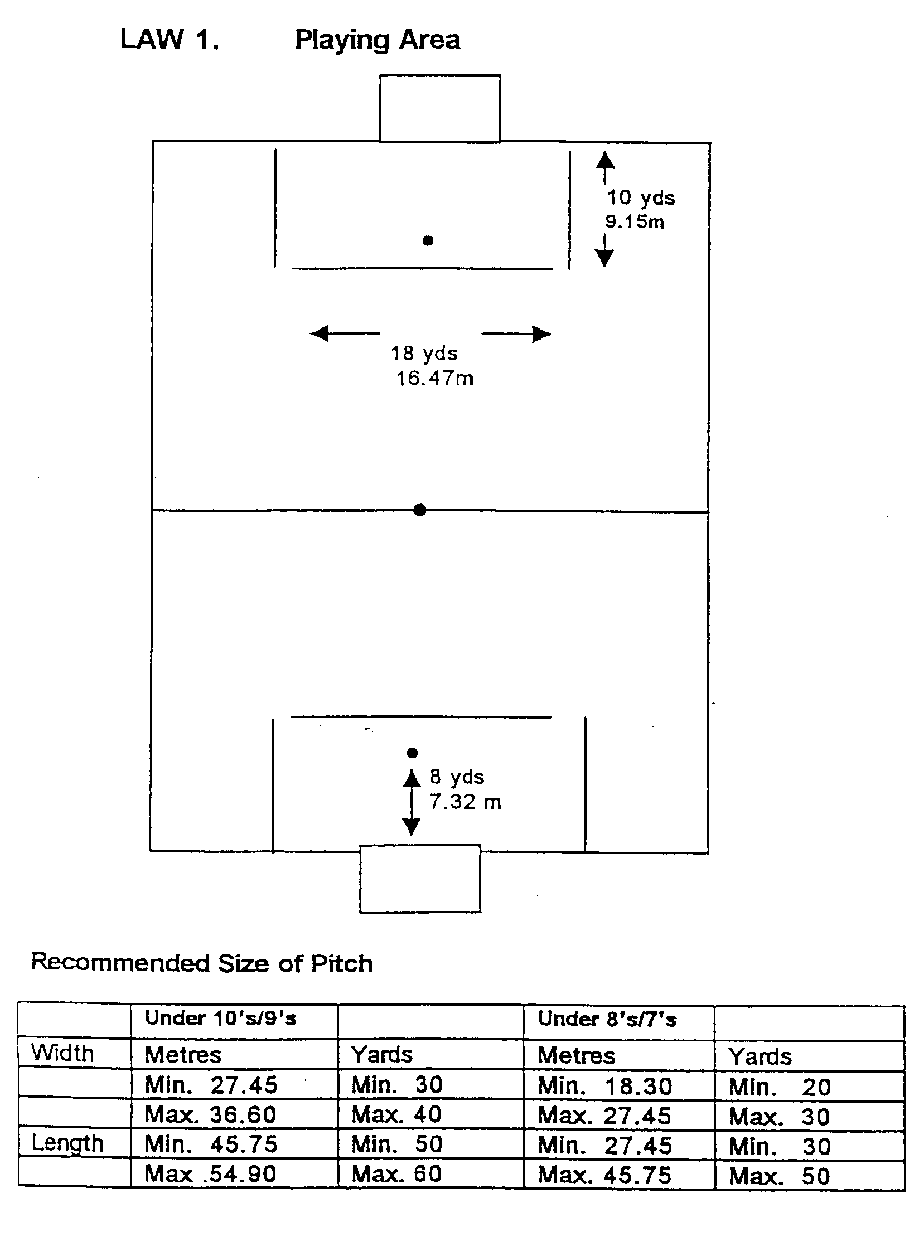
Penalty Area Length 9.15 m - 10 yards Width 16.47m - 18 yards Penalty Mark The penalty mark is 7.32m (8 yards) from the Goal Line opposite age Centre of the Goal. Halfway Line The field of play is divided into two halves by a halfway line. The centre mark is indicated at the mid-point of the halfway line.
LAW 1. Goal Size The distance between the posts is 3.6m (1 2ft) and the distance between the lower edge of the cross bar and the ground is 1.88m (6ft). Warning In view of a number of accidents that have occurred, it is necessary to ensure that portable goals of any size are either pinned or weighted to prevent them from toppling forward. LAW 2. The Ball The ball should be no larger than size 4. Size 3 is recommended for Under 8's. It should be safe and made of leather or another suitable material.
LAW 3. Number of Players Number per Team Including Goalkeeper Over 6 and Under 8's - 4 v 4 and 5 v 5 Over 8 and Under 10's - 6 v 6 and 7 v 7 Players must play with and against players only from their own age range - within a two year age band. Players should not be allowed to begin to play until the Season of their 7th birthday. Each team must not have a squad greater than double the size of the team per age. Any number of substitutes, without being named, may be used at any time with the permission of the referee or game leader. Entry into the field of play will only be allowed during a stoppage in play. A player who has been replaced may return to the playing area as a substitute for another player.
LAW 4. Playing Equipment Players must wear shinguards and goalkeepers must wear a distinguishing playing strip. Shinguards must be covered entirely by the stockings.
LAW 5. Referee's - The Authority of the Referee. Each match is Controlled by a referee who has full authority to enforce the Laws of the Game in connection with the match to which they have been appointed. Powers and Duties The Referee: • Enforces the Laws of the Game • Controls the match in co-operation with the assistant referees / time keeper • Ensures that the ball meets the requirements of Law 2 • Ensures that the players' equipment meets the requirements of Law 4 • Stops, suspends or terminates the match, at their discretion, for any infringements of the Laws • Stops, suspends or terminates the match because of outside interference of any kind • Stops the match if, in their opinion, a player is seriously injured and ensures that they are removed from the field of play • Ensures that any player bleeding from a wound leaves the field of play • Allows play to continue when the team against which an offence has been committed will benefit from such an advantage and penalises the original offence if the anticipated advantage does not ensue at that time • Takes disciplinary action against players guilty of cautionable and/or sending-off offences. • Takes action against team officials who fail to conduct themselves in a responsible manner and may, at their discretion, expel them from the field of play and its immediate surrounds • Ensures that no unauthorised persons enter the field of play • Restarts the match after it has been stopped Decisions of the Referee The decisions of the referee regarding facts connected with play are final. The referee may only change a decision on realising that it is incorrect or, at his/her discretion provided that play has not restarted.
LAW 6. Timekeeper/Scorer/Assistant Referee Duties A person may be nominated to assist the referee to: (a) Record goals scored; (b) Act as timekeeper and signify to the referee by an agreed signal when the time of each half has expired; (c) , Suspend time on an instruction from the referee for all stoppages and add that time to the end of each half; Supervise the use of rolling substitutes. (d)
(e) Carry out any other duties as prescribed by the referee; If an independent timekeeper/scorer is not nominated, these duties are the responsibility of the referee.
LAW 7. Duration of Game In any one day, no player shall play more than the stipulated period outlined below. Within this maximum the recommended duration of games is provided. Recommended Number of Minutes each half Over 6 and Under 8 - 10 minutes Over 8 and Under 10 - 15 minutes Maximum Duration of Participation per Day Per Player Over 6 and Under 8 -45 minutes Over 8 and Under 10 -60 minutes Each league/competition will determine its own playing time within the maximum time Permitted. The half time interval must not exceed 5 minutes.
LAW 8. Start and Restart of Play Procedure A kick-off is taken at the centre of the playing area to start the game and after a goal has been scored, opponents must be 4.5m (5 yards) away from the ball, and in their own half of the field. The ball must be played forward. Special Circumstances A dropped ball to restart the match after play has been temporarily stopped inside the penalty area takes place on the penalty area line parallel to the goal line at that point nearest to where the ball was located when the play stopped
LAW 9. Ball in and out of Play Ball Out of Play The ball is out of play when: • it has wholly crossed the goal line or touch line whether on the ground or in the air • Play has been stopped by the referee
Ball in Play The ball is in play at all other times including when: • it rebounds from a goal post, crossbar or corner flag post and remains in the field of play • it rebounds from either the referee or an assistant referee when they are on the field of play
LAW 10. Method of Scoring Goal Scored A goal is scored when the whole of the ball passes over the goal line, between the goalposts and under the crossbar, provided that no infringement of the Laws of the Game has been committed previously by the team scoring the goal. Winning Team The team scoring the greater number of goals during a match is the winner. If both teams score an equal number of goals, or if no goals are scored, the match is drawn. Competition Rules For matches ending in a draw, competition rules may state provisions involving extra time, or other procedures approved by the International F.A. Board to determine the winner of a match. Please note this must be included within the maximum participation time.
LAW 11. Offside There is no offside.
LAW 12. Fouls and Misconduct In Mini Soccer all free kicks are direct. A free kick is awarded to the opposing team if a player commits any of the following offences in a manner considered to be careless, reckless or using excessive force: • Kicks or attempts to kick an opponent • Trips or attempts to trip an opponent • Jumps at an opponent •, Charges an opponent • Strikes or attempts to strike an opponent • Pushes an opponent • Tackles an opponent to gain possession of the ball, making contact with the opponent before touching the ball A free kick is awarded to the opposing team if a player commits any of the following offences: • Holds an opponent Spits at an opponent Handles the ball deliberately except for the goalkeeper within his/her own penalty area) Plays in a dangerous manner Impedes the progress of an opponent Prevents the goalkeeper from releasing the ball from his/her hands Commits any other offence, not previously mentioned in Law 12, for which play is stopped to caution or dismiss a player Penalty Kick A penalty kick is awarded if any of the above offences is committed by a player inside his/her own-penalty area, irrespective of the position of the ball, provided it is in play. A free kick is awarded to the opposing team if the goalkeeper: • Takes more than 6 seconds to release the ball from his/her hands • Touches the ball again with his/her hands after it has been released from his/her possession and has not touched any other player • Touches the ball with his/her hands after it has been deliberately kicked to him/her by a team mate • Touches the ball with his/her hands after he/she has received it directly from a throw in taken by a team mate For all of these offences, the free kick should be taken from the penalty area line, parallel with the goal line, at the nearest point to the offence Cautionable Offences A player is cautioned and shown the yellow card if he/she commits any of the following seven offences:
1. Is guilty of unsporting behaviour 2. Shows dissent by word or action 3. Persistently infringes the Laws of the Game 4. , Delays the restart of play 5. Fails to respect the required distance when play is restarted with a corner kick or free kick 6. Enters or re-enters the field of play without the referee's permission 7. Deliberately leaves the field of play without the referee's permission Sending off Offences A player is sent off and shown the red card if he/she commits any of the following seven offences: 1. Is guilty of serious foul play 2. Is guilty of violent conduct 3. Spits at an opponent or any other person 4. Denies the opposing team a goal or an obvious goal scoring opportunity, by deliberately handling the ball (this does not apply to a goalkeeper within his/her own penalty area) 5. Denies an obvious goal-scoring opportunity to an opponent moving towards the player's goal by an offence punishable by a free kick or a penalty kick 6. Uses offensive or insulting or abusive language and/or gestures 7. Receives a second caution in the same match
LAW 13. Free Kicks For all free kicks opponents must be 4.5m (5 yards) from the ball.
LAW 14. Penalty Kicks A penalty kick is awarded for offences, as described in Law 12. Position of the Ball and the Players All players except the defending goalkeeper and kicker must be outside the penalty area and at least 4.5m (5 yards) from the penalty mark. The ball must be kicked forward. Infringement/Sanctions If a player or players commit an offence at the taking of a penalty kick his/her team shall not be allowed to gain an advantage (i.e. the kick is retaken or the goal is disallowed depending on which team offended). If a player of both the defending and the attacking teams offend, the kick shall be retaken .
LAW 1 5. Throw-in A goal cannot be scored directly from a throw-in. A throw-in is awarded: • When the whole of the ball passes over the touch line, either on the ground or in the air • From the point where it crossed the touch line • To the opponents of the player who last touched the ball Procedure At the moment of delivering the ball, the thrower: • Faces the field of play • Has part of each foot either on the touch line or on the ground outside the touch line • Uses both hands • The throw-in is awarded to the opposing team, if any of these requirements are not carried out • Delivers the ball from behind and over their head The thrower may not touch the ball again until it has touched another player. If he / she does a free kick will be awarded against them. The ball is in play immediately it enters the field of play.
LAW 16. Goal Kick Procedure A player of the defending team kicks the ball from any point within the penalty area. Opponents must remain outside the penalty area and at least 5 yards (4.5m) from where the kick is taken until the ball is in play.
LAW 17. Corner Kicks The opposing players must remain at least 4.5m (5 yards} from the ball until it is play. The kicker may not touch the ball again until it has touched another player. If he / she does a free kick is awarded against them. The ball is in play immediately it enters the field of play .
|